
I wanted to share some thoughts on the research conducted by our engineering team, and about the motivation behind going solar—whether it’s driven by fear (loadshedding) or thoughtful financial planning.
To substantiate this debate with factual information, we asked AWPower Chief Design Engineer Lourens Delport to dig into our historical cost calculators over the past 5 years for solar PV designs, and to compare the cost of generating electricity from solar for residential and commercial use, versus the cost of buying grid-supplied electricity from the City of Cape Town.
Interesting to note, from about the third quarter in 2021, it became more economical to generate electricity from solar.
AWPower research into costing trends
Our research into the costs of a typical 8kVA inverter, 10kWh battery and 5.6kWp PV system, with a pessimistic life expectancy of 10 years (PPA agreements amortise costs over 20 years), plotted against a monthly estimated consumption of 770kWh on the City of Cape Town’s Home User Tariff, indicated that the cost of self-generation from PV started to beat City of Cape Town from the 3rd quarter of 2021, with this trend rapidly accelerating from 2023, as shown in the graph below.
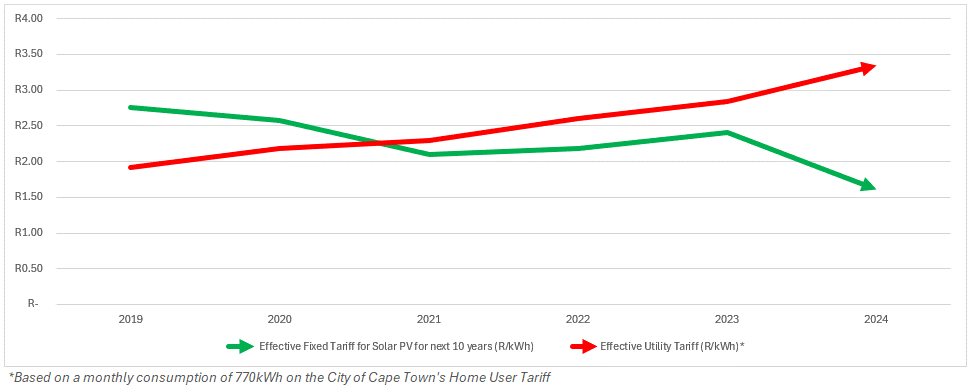
The Trend: Fear vs. Thoughtful Investment
In South Africa, the trend has been to invest in solar PV systems when load shedding was at its peak, yet the reality is clear: it is more cost-effective to self-generate solar power for your own consumption rather than relying on utilities.
Our findings are that more businesses are investing in solar, based on solid financial analysis, as the evidence of savings is substantial and compelling. With statistics showing that solar penetration within the South African market is currently at 0.7%, there is room for growth and massive savings to be generated.
Benefits You Should Know About:
- Economical Self-Generation: Since 2021, generating your own solar power has been more cost-effective than buying from utilities, with the gap rapidly growing.
- Financing: Both businesses and private individuals have access to favourable financing options for solar investments, however, we still find that some banks are sceptical about financing institutions like retirement villages.
- Cost Savings Cover Instalment: When financing, the savings generated from solar power can cover your monthly finance instalments, creating a positive cashflow.
- Business renewable energy tax incentive: This will allow a reduction of taxable income up to 125% of the cost of renewable energy assets used for electricity generation.
- Property Value Increase: Solar installations add significant value to properties, enhancing their market appeal.
- Futureproofing for Electric Vehicles: With the rise of electric vehicles (EVs), generating your own energy reduces direct running costs to almost zero, especially beneficial for commercial fleets where fuel is one of the largest expenses.
- Charging your EV from solar: Home or Commercial Building chargers are normally AC with a maximum charge rate of 22kW which will prolong battery life, vs fast DC charging of 60kW or more.
- Excess Generation Benefits: A solar PV installation that generates enough electricity for winter consumption, will normally have excess capacity in summer, allowing for exporting to the grid, and aiding in payback and sustainability.
- Off-Grid Potential: With rising utility costs and added levies, going off-grid becomes more attractive, but enough capacity in winter will mean excess in summer, and being disconnected from the grid without the ability to export, may result in an unproductive system in summer.
- Modular Start: Starting with a modular solar system is easy and provides a solid foundation for future expansion.
Challenges and Considerations
Despite the clear benefits, there are challenges to be aware of:
- Rising Costs: Electricity price increases have jumped from around 9% per year to between 12-18%, and Eskom has proposed higher fixed capacity charges regardless of usage. Prices will continue to rise exponentially.
- Utility Resistance: Utilities are under financial pressure, as margin on electricity sales do fund their operations, typically covering their salary & wages expenses. Despite public endorsements, this often leads to higher prices and resistance to consumer solar adoption.
- Municipal Hurdles: Municipalities are slow to adopt solar-friendly policies. They could benefit from allowing electricity export to the grid, buying at lower costs than from Eskom, and adopting sustainable business models.
- The City of Cape Town was very proud to announce a new online application process via e-services, a “Cash for Power” programme and lower-cost equipment for exporting to the grid, however, this process for handling applications online has been met with resistance from property owners due to the admin required to sign-up and may benefit by having more support available during the registration phase.
- Export to the grid: Normally it will be economically viable to export from 3-phase installations having excess solar available, whereas single-phase installations may not be viable but can be with the new cheaper AMI meter revealed earlier this year.
Conclusion
The decision to go solar should be a strategic one, driven by thoughtful consideration of the long-term benefits rather than just a response to load shedding. With the right approach, solar power can provide significant cost savings, enhance property values, and contribute to a more sustainable future. Now is the best time to invest in solar!
At AWPower, we are here to help you navigate this journey, offering expertise and solutions tailored to your needs.
Invest in solar today and take control of your energy future.