
A Smarter Approach to Water & Waste Management
South Africans are no strangers to water shortages, failing infrastructure, and sewage spills. We’ve seen raw sewage polluting rivers, oceans, and communities, and often, the cause is outdated and inefficient pump stations.
According to the Department of Water and Sanitation’s 2022 Green Drop report, about half of the country’s 850 municipal wastewater treatment works are failing, with 334 in a critical state. This failure results in billions of litres of untreated or poorly treated sewage contaminating our water bodies annually.
Furthermore, a 2025 report by the Mail & Guardian highlighted that more than 50,000 litres of sewage flow into South Africa’s rivers every second, primarily due to neglected infrastructure and outdated wastewater treatment plants.
These alarming statistics underscore the urgent need to modernise our sewage and wastewater management systems. Many pumping stations in South Africa are not functioning effectively because of ageing equipment, outdated design, lack of maintenance and lack of electricity to power the pumps.
How? By implementing efficient pump station technologies which are crucial to safeguarding our water resources and public health.
Why Pump Stations Matter
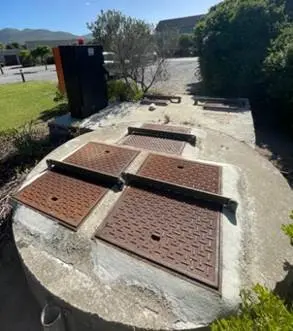
Pump stations are vital infrastructure, responsible for supplying water, draining low-lying areas, and transporting sewage to processing sites. However, many pump stations across South Africa are struggling due to:
- Ageing equipment that can’t keep up with demand
- Outdated designs that lack automation and efficiency
- Poor maintenance leading to unexpected failures
- Electricity supply challenges and loadshedding / area outages affecting operations
The Problem with Old Pump Stations
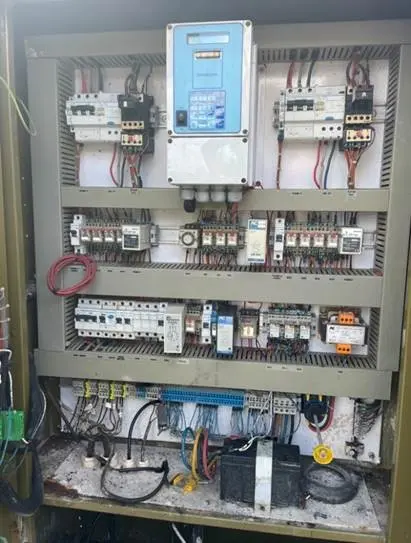
The typical older sewage pumping station will be equipped with twin 3-phase submersible pumps that are controlled by an array of switchgear, and the level of fluid in the sewage chambers are measured by submerged float switches, which are prone to wear or clogging by fatty deposits. It is not easy to spot malfunction except to experience no supply of water or sewage discharge into the neighbouring area.
Overflow of sewage could be unexpected, especially following a heavy downpour when sewage chambers are typically prone to being overloaded.
A major problem facing maintenance personnel is that they have no insight into the actual level of the sewage chambers, nor the condition of the switchgear or pumps installed in the chamber, unless they open the hatches and physically look at the levels. If a component in the traditional pump station fails, first signs could be a spill of the sewage sump into the surrounding area.
The Modern Solution to Pump Station Management
The good news is that solar pumping inverters have been developed to overcome the problems with old traditional mechanical systems, and in addition to providing automation and reliability, pumping inverters can also be powered by solar PV, allowing for energy security as well as savings.
How it works:
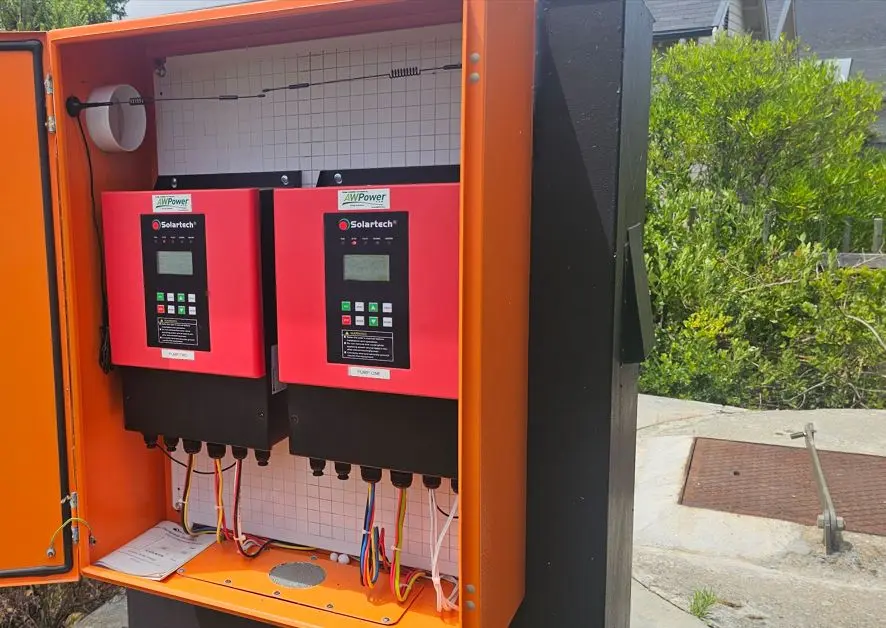
Solar pumping inverters such as Solartech (pictured below), replaces all the functions provided by the traditional pump station, and more, including cloud-based remote monitoring and control, providing visibility, cost-effectiveness and a much more reliable solution.
A Solartech pump inverter being connected to a water or sewage pump, becomes the “brain” of the surface or submersible pump, becoming a fully digitised and programmable solution that measures the level in the liquid, switches the pumps on or off, depending on the desired levels programmed into the pump inverter.
A pump inverter can also sense when a pump reaches an abnormal temperature or if there is water ingress, or if there is an imbalance in the 3-phase electricity supply, and it will safeguard the equipment by shutting down and sending an alert. And all this data is transmitted to a cloud-based information storage and reporting system, allowing full remote monitoring and control of the pump station.
In Summary
Apart from reliable operation and huge potential savings in grid-supplied electricity, a pump inverter can transmit the full status and performance of the pump station in digital format to an audience that is responsible for its management, providing insight in the form of alerts, graphs and numbers to monitoring dashboards, PC displays and mobile equipment.
This important feature allows for pro-active management which could mitigate the risk for loss of electric power, water or sewage overflow.
Solution designed & supplied by AWPower
For a real-world example, Lake Michelle Estate in Noordhoek, Cape Town, has already upgraded to a solar-powered pump system. Read more about their success story.
“We are proud to be associated with AWPower. The company went out of its way to assist and design new user-friendly technology through solar and pump inverters, that will help manage our sewer pump stations, resulting in huge savings. They went the extra mile to “think outside the box” and help us become the first estate in the country that will be using the technology they introduced to better manage sewer levels, create savings and make us a leader in the industry. Their workmanship is of the highest standards. We can recommend AWPower to any company and welcome you to call us to discuss our successes.”
Henk Booysen, Estate Manager, Lake Michelle Home Owners Association (Noordhoek, Cape Town